This is a developing story about the Federal Reserve's March interest rate cut decision. Please check back for updates.
The Federal Reserve on Wednesday announced it will leave interest rates unchanged, amid a softening labor market and growing uncertainty over the war in Iran.
Fed policymakers voted to leave the benchmark federal funds rate unchanged at its current range of 3.5% to 3.75%. The move follows the central bank's decision to hold rates steady in January after three successive 25-basis-point rate cuts in September, October and December to close out last year.
Economic data showing a slowdown in the labor market, inflation continuing to run hotter than the Fed's 2% target and the unrest in Iran prompted policymakers to continue to pause rate cuts.
The Federal Open Market Committee (FOMC) voted 11-1 in favor of leaving rates unchanged, with the lone dissent by Fed Governor Stephen Miran, who was in favor of a 25 basis point cut.
The FOMC's statement noted that economic indicators suggest the economy is expanding at a solid pace, with low levels of job gains and somewhat elevated inflation.
It also noted that uncertainty surrounding the economic outlook "remains elevated" and that the "implications of developments in the Middle East for the U.S. economy are uncertain."
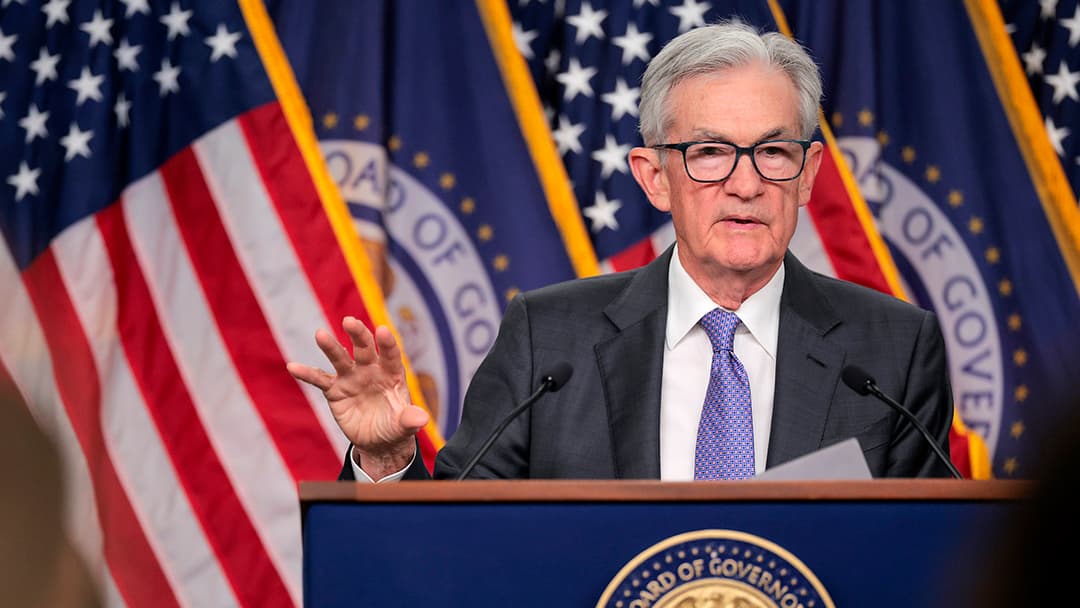
Federal Reserve Jerome Powell said at a press conference announcing the decision that the slowdown in hiring reflects lower demand for labor as well as a decline in immigration. He added that inflation readings remain elevated in the goods sector due to the effects of tariffs raising consumer prices.
Powell said that the current 3.5% to 3.75% range for the benchmark federal funds rate is within a range of neutral. He added that it's too soon to tell what the impact of the conflict in the Middle East will be on the economy, and that policymakers will continue to monitor economic data as they consider adjusting monetary policy.
The Fed chair was asked whether the central bank will look through the inflation that stems from higher oil prices in the Middle East. Powell said the Fed needs to see goods inflation slow as the one-time price increase from tariffs flows through the system before it can consider the new energy inflation.
"The question of whether we look through the energy inflation doesn't really arise until we have kind of checked that box," he said. "It is kind of standard learning that you look through energy shocks, but that's always been on inflation expectations remaining well-anchored."
Powell noted that total core inflation is at about 3%, well above the Fed's 2% target, and he added that "some big chunk of that, between a half and three-quarters, is actually tariffs."
Another question posed to Powell was regarding whether the impact of the Middle East conflict on gas prices could spur increased domestic production.
"If you ask oil companies about doing more drilling, though, they're going to want to see a consistent rise in oil prices from where they were before the build up for the war, and they're going to want to believe that that's going to be persistent for a fairly long time," he explained. "I wouldn't say there's much of that happening now, but some of that could happen over time."